We don’t know exactly when my father-in-law, Barry started showing signs of frontotemporal dementia. We believe there may have been subtle changes in his personality that went unnoticed for years as he has always been an unconventional character. However, following a Traumatic Brain Injury after falling down a set of concrete stairs, we noticed a marked change in his personality and behaviour, which continued to decline over the next 10 years.
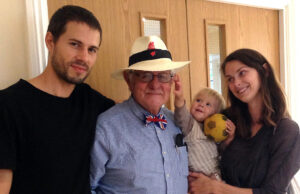
Shortly after this Barry started acting strangely during family dinners out; he would often be rude towards us and would continuously interrupt other diners to show them his photographs or to dictate quotes. As Barry was a renowned photographer, these interruptions were usually met with a kind exchange, so although we found his behaviour to be strange and a bit embarrassing, we didn’t think it was much to worry about.
Over time Barry’s behaviour became increasingly erratic and things became very challenging. Barry started to be sexually inappropriate towards me, which I found so upsetting I refused to see him at times. He often had angry outbursts, lacked insight, was impulsive and was impossible to contain in social settings. Sometimes he would pull down his trousers whilst walking in the street or urinate on car bonnets. He upset people with uninhibited comments on a regular basis, and was sometimes physically attacked by offended strangers.
My husband took him to his GP and a specialist consultant at a clinic for the elderly. With dementia in mind, memory assessments were carried out, something which tends to be unaffected until much later on in behavioural FTD and as a result nothing was flagged-up. We were increasingly worried for his wellbeing and for the effects his behaviour may have on others and eventually our fears were confirmed when he was arrested for sexually inappropriate behaviour.
Barry spent the next 8 months in custody, during which time his mental and physical health declined dramatically, which was extremely distressing for us all. Since his diagnosis we have found this is not a unique scenario as over a third of people with FTD act out criminal behaviours.
Whilst in custody Barry was assessed by forensic psychiatrists, which again raised nothing of concern. Only after a clinical neuropsychologist ran a series of tests on all aspects of his executive function did we find out that he was severely cognitively impaired, particularly in regards to disinhibition. Following his release from custody it became apparent he could no longer live independently safely and he was sectioned under the mental health act. After being placed in a secure hospital he was eventually diagnosed with FTD, which was likely caused or exacerbated by his brain injury.
We wish everyone was more aware of the behavioural symptoms of FTD and which assessments are required so things hadn’t have escalated to such a degree, but we feel relieved that Barry eventually received a full diagnosis and appropriate care as there must be many others who never do and remain in prison.
Barry still doesn’t fully understand why he has been ‘incarcerated’ and it is heart-breaking for us to see a once proud, accomplished and vibrant man in a restrictive secure unit, but we have accepted that there is no alternative and that he is receiving the most appropriate care for his condition. When we visit him he is now mostly a pleasure to be with, thanks to the medication, therapies and strategies that have been put in place for him. Whenever he is inappropriate towards us, with an understanding of his condition we are now able to respond more effectively and, at times, even see some humour in it.
FTD has been and continues to be an isolating experience for our family. It is easy to understand experiences of more common forms of dementia. The sadness of a loved one losing their memories, modes of communication or sense of self is easy to empathise with. But a rare form of dementia which results in sociopathic behaviours, whilst everything else remains seemingly intact is difficult to comprehend. Only via RDS did we discover families with similar experiences. We hope that sharing our story also helps others feel less alone in their experience of behavioural FTD.
Written by Zoe and Dylan Lategan
