Volunteering and awareness
RDS Champions is a volunteer programme that harnesses the passion, experience and commitment of RDS members, former members, their families and friends to raise awareness of rare dementia, support others, and help improve professional understanding.
Many people living with rare dementia face long delays in receiving a diagnosis, while others never receive an accurate diagnosis at all. Limited awareness of rare dementias and difficulties accessing appropriate support and care can create significant challenges. As part of our commitment to supporting people affected by rare dementia, RDS is working to improve awareness, understanding and access to services.
The RDS Champions programme enables volunteers with lived experience to work alongside the RDS team as ambassadors and advocates for the rare dementia community. Champions contribute in a variety of ways, with a range of roles and levels of commitment to suit different interests, skills and availability.
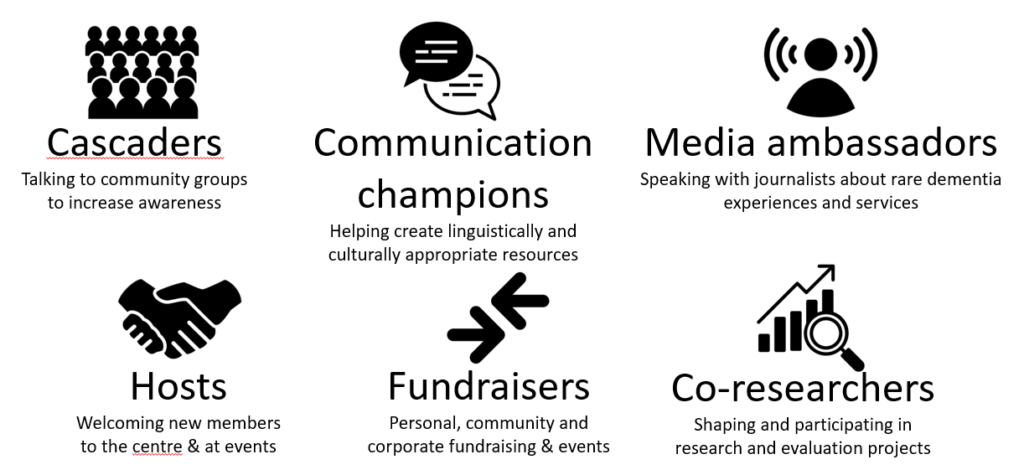
Equipped with resources and support from RDS staff, our champions volunteer their time for one or more of the champions volunteer roles, which include:
By increasing awareness among communities, healthcare professionals, policymakers and underrepresented groups, we aim to:
Through the programme, champions can make a meaningful contribution while helping to improve understanding, reduce barriers to support and improve outcomes for people affected by rare dementia.
For more information about ways to get involved as a volunteer RDS champion please email contact@raredementiasupport.org.
Sharing lived experience with health professionals and members of the public
RDS cascaders are RDS members who are willing to give short talks in their community to share their knowledge and lived experience and help to describe the rare dementias that RDS supports. We hope that cascaders will raise awareness and increase understanding about the rare dementias and spread the word about RDS.
RDS now has three cohorts of RDS cascaders, who are getting out into communities all around the UK to share their stories of living with or caring for someone with a rare dementia. Here, Nalini tells us a bit more about why she got involved and shares some of her and her husband Phil’s story.
By becoming a cascader I want to increase the awareness of rare dementias so that healthcare professionals and individuals are better equipped to support people living with rare dementias. The approach taken by RDS in the Cascaders Programme is to provide facts about the different types of rare dementia as well as giving personal experiences of those with the condition or as a carer. I am hoping that by giving these informative short talks, ‘diagnosis by chance’ will be reduced. Individuals will get an opportunity to meet others in similar situations as well as a range of professionals to get advice and support.
My husband Phil was diagnosed with Primary Progressive Aphasia (PPA) in February 2020. Phil started exhibiting difficulties with finding words around 10 years earlier, he substituted words or described things to overcome this difficulty. We put this down to him getting older. In 2018, Phil admitted he was finding difficultly reading and writing. He was diagnosed with “unspecified dementia” given he was exhibiting symptoms of cognitive impairment however there was no evidence of vascular dementia or Alzheimer’s. The local medical professionals were unaware of rare dementias, however a psychiatrist did mention the possibility that Phil may be living with PPA. It was quite by chance that I came across Rare Dementia Support – a friend of mine had a family member who had a rare dementia and gave me the details of the organisation and through the website I worked out that Phil in all likelihood had PPA. I attended a PPA workshop in mid-2019 which allowed me to meet people living with PPA and their carers. In those meetings I was provided with information about the types of PPA and the strategies that could help us to manage day-to-day living. RDS also supported me in obtaining a proper diagnosis of Phil’s condition which meant we received additional support from various experts. This was not only for Phil, I too received support in many ways from having nurses I could check symptoms and behaviours with through to support groups connecting me with others in similar situations. I also had help through the grief process as I ‘lost’ the real Phil, as well as bereavement support when he passed away.
Nalini, RDS Cascader

For more information about ways to get involved as a volunteer RDS champion please email contact@raredementiasupport.org
Helping create linguistically and culturally appropriate resources
Too few people ever receive the diagnosis they deserve or the tailored information they and their families need to access the right support at the right time. We want this information to be available to all. RDS members willing to contribute their linguistic skills and cultural expertise can help by contributing to translations and interpretations of written, audio and video resources, and by sharing their story in their own language and style.
Our recent translation project aimed to bridge some of these gaps by creating information sheets and films about the seven rare dementias we support in 16 different languages, including Chinese, French, German, Italian, Japanese, Spanish, Arabic, Bengali, Portuguese, Gujarati, Hindi, Polish, Punjabi, Tamil, Urdu and Russian. We hope these resources can be used to deepen understanding about different forms of dementia in all corners of society.
We are keen to expand the range of resources available, the number of languages in to which they are translated and the different communities for whom they are helpful. So we would be very grateful if you or someone you know – perhaps a family member or friend who is keen to help – would like to volunteer your language skills for future translation or proofreading work.
For more information about ways to get involved as a volunteer RDS champion please email contact@raredementiasupport.org
Speaking with journalists about rare dementia experiences and services
RDS is regularly approached by TV, radio, newspapers and other media for comment on events, research and services relevant to those living with dementia and the wider public. Media ambassadors can make these stories more personal and impactful. Volunteers don’t need media training or experience; just a willingness to share their experience or opinion in an authentic manner.
Recent examples of RDS members in the media include:
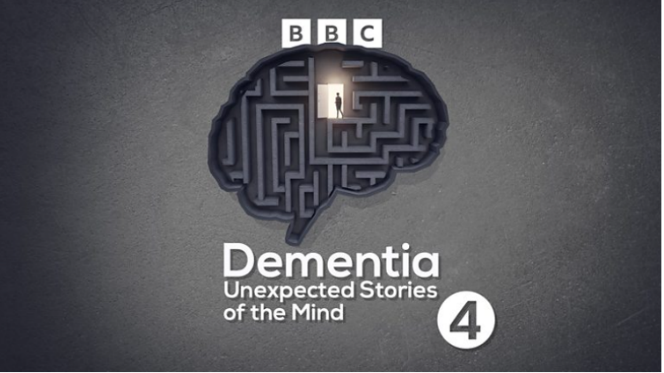
In this five-part series, neurologist Jules Montague and William Miller go into the homes of people with rare dementias, to discover that dementia is not what we think it is. The series features RDS member Jacqui discussing frontotemporal dementia, Dave and Gill talking about Lewy body dementia, Susan and Terry explaining posterior cortical atrophy, and Jo talking about semantic dementia.
Click here to read more about the background to this project and to listen to the episodes.
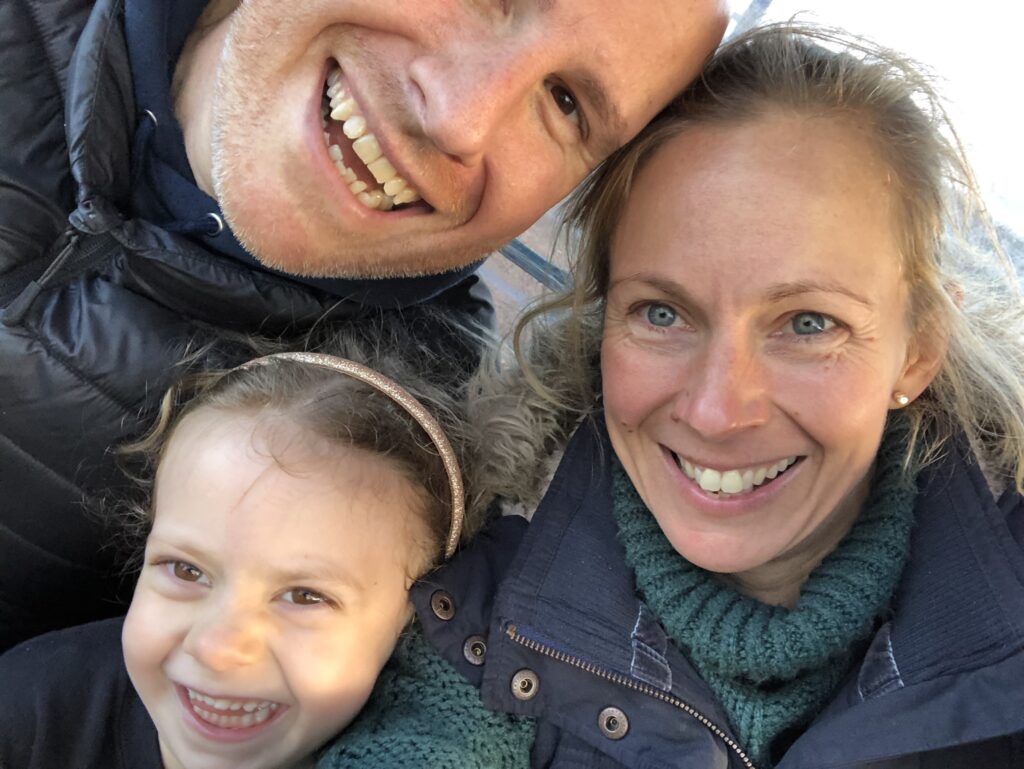
Sarah Dolling lost her father, aunt and grandmother to familial Frontotemporal dementia (FTD), and has the gene herself. She has raised awareness of both the disease and the work we do at Rare Dementia Support through the media, as well as Rare Dementia Support’s own platforms and The National Brain Appeal. She has also shared her fundraising effort for RDS widely, and runs her own Instagram account called Project 71 to raise awareness.
There are many options for media ambassadors, some would rather focus on print, or radio or broadcast television, while others would rather write something for our website or print materials. Though our media ambassadors are usually named, there is no pressure to do this and we would still love to share your story anonymously or with your first name.
For more information about ways to get involved as a volunteer RDS champion please email contact@raredementiasupport.org
Welcoming new members and facilitating
RDS hosts lots of in-person and online meetings, as one of our main reasons for being to enable members to meet other people in the same boat. As more established members of the RDS community, event hosts can play a key role in welcoming new members, making introductions and helping people to feel comfortable and relaxed.
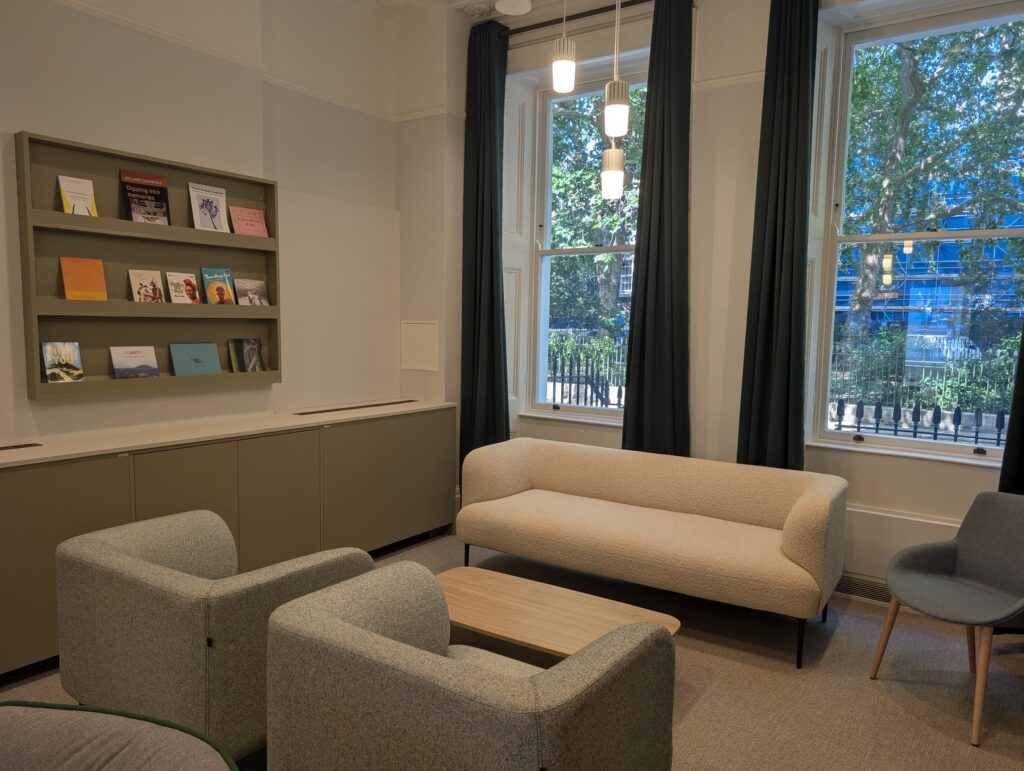
Hosts will also play a key role in helping people feel at home at The Hilary and Galen Weston Rare Dementia Support Centre. Volunteers will receive training as they welcome visitors who may be coming for a scheduled meetings, or may turn up having just received some life-changing news in clinic. The purpose of placing the kitchen at the heart of the Centre is that the first question asked on arrival will not be “Who are you? What are you here for?” but “Would you like a coffee? And some cake with that?”
For more information about ways to get involved as a volunteer RDS champion please email contact@raredementiasupport.org
Personal, community and corporate fundraising and events
The support, information and community provided by RDS are, and we hope will always remain, free at the point of use. However, these services are only possible thanks to the generosity, dedication and creativity of our supporters.
Fundraising champions play a vital role in helping RDS continue its work. Whether organising a local event, taking on a personal challenge, raising awareness in their community, or making introductions to potential partners, every contribution helps us reach and support more people affected by rare dementia.
The National Brain Appeal, which funds the RDS service, is delighted to support anyone who would like to raise funds or awareness for RDS support services and research. They can also help explore opportunities for corporate partnerships, sponsorship and other valuable connections.
For more information about becoming a fundraising champion or any other RDS champion volunteer role, please email contact@raredementiasupport.org.
Shaping and participating in research and evaluation projects
Much of the innovative research conducted into the causes, consequences and support needs associate with each rare dementia has been inspired directly by people living with these conditions. Co-researchers can help by highlighting important questions, contributing to the design of new research, reviewing and improving existing research practice, and sharing the outputs and outcomes of that research.
One way to be a co-researcher if to join one of our focus groups. For more information about ways to get involved as a volunteer RDS champion please email contact@raredementiasupport.org
To find out more about taking part in a research through our clinical trials or observational studies, head to our Take part in research page.
The RDS team boasts considerable knowledge and expertise about different forms of dementia and how best to support those affected. However, the team members are also very aware that much of that knowledge originates not from books or learning or being smart, but from the enormous privilege of thousands of conversations with individuals whose lives have been touched in different ways by a rare dementia.
The RDS community is founded on the benefits of a reciprocal relationship between ‘peers’ and ‘professionals’. Neither constituency holds all the information or expertise, and all are experts whether by training, experience or both.
Sharing this experience and expertise is key to the success of RDS. You do not have to become one of our champions or ambassadors to make an impact. Sometimes that sharing will be at a support group meeting, or might occur by someone becoming part of a one-off or regular focus group helping to shape the development of services or research.
But often that sharing will be in smaller, less planned ways, like in a one-to-one support conversation, over a cup of coffee around the edges of a group meeting, or with a nurse or researcher whilst waiting for a clinical appointment or research assessment. These more informal contributions are every bit as valuable, and a simple way in which anyone could contribute to the RDS and wider dementia support and research communities.
You might be interested in these stories about different types of informal contributions to research.
So thank you for all your already have contributed, whether you realise it or not. If you would like to share further ideas or experiences, or would be willing to contribute to focus groups now or in the future, please let us know at: contact@raredementiasupport.org